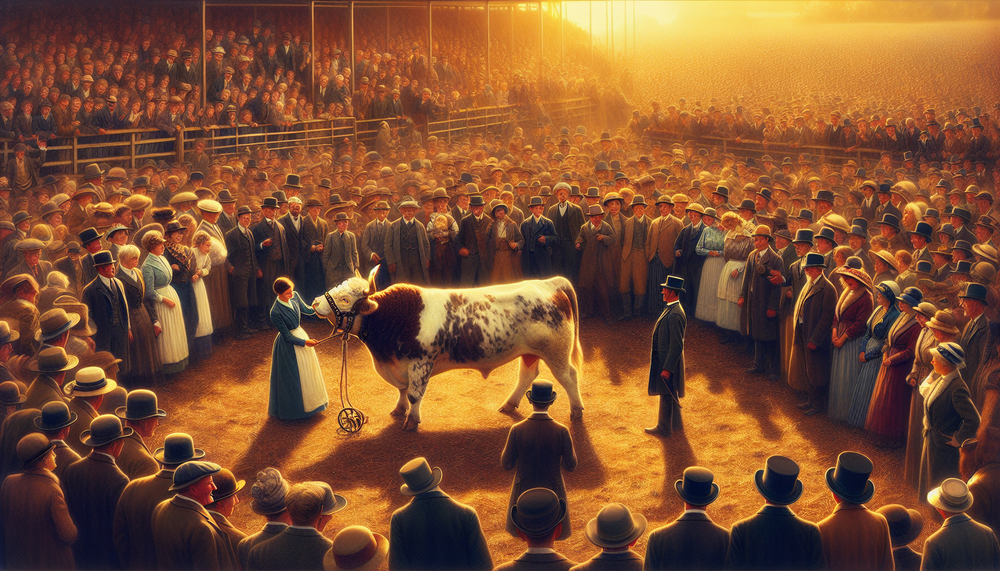
In 1906, an English statistician walked into a country fair in Plymouth expecting to prove that ordinary people make terrible decisions.
He left with the opposite answer — and a number that should change how you read every economic forecast headline this year.
The fair had a contest. Guess the weight of a slaughtered ox. The closest answer wins a prize. Around 800 people paid sixpence to scribble a guess on a numbered card. Butchers, farmers, clerks, housewives, kids who had never touched a cow.
Francis Galton borrowed the cards afterward to do something nobody else had thought to do. He averaged them.
787 strangers. One ox. A 1-pound miss.
After throwing out 13 illegible cards, Galton was left with 787 guesses. The average came to 1,197 pounds. The actual dressed weight of the ox was 1,198 pounds.
The crowd was off by less than 0.1%. No individual expert at the fair came that close. Not the butchers. Not the cattle farmers. Not anyone who had spent their life staring at livestock.
Galton had set out to prove the average voter was an idiot. Instead, he had stumbled onto the foundation of every modern prediction market.
Why your wrongness is the whole point
The math behind it is almost insulting in its simplicity. Each guess is wrong in its own direction. Some too high, some too low. When you add enough independent guesses together, the errors cancel each other out.
What's left is the signal — the actual information shared across the crowd, minus the noise of any single person's bias.
This only works under three conditions: people guess independently, the group is diverse, and somebody aggregates the answers honestly. Take away any one of those and you don't get wisdom — you get a mob.
That's why Twitter polls fail and Galton's ox didn't. Independence is the magic ingredient nobody talks about.
The market that beat 964 polls
If this sounds abstract, look at the Iowa Electronic Markets. Since 1988, the University of Iowa has run real-money markets where traders buy and sell contracts on US election outcomes. Stakes are capped at $500 to keep it honest.
Researchers later compared IEM forecasts to 964 traditional polls across five presidential elections. The market was closer to the actual outcome 74% of the time. The further out from election day, the bigger the gap.
The mean absolute error for the market was 2.65 percentage points. For polls, 4.49. The crowd of self-selected traders, putting their own money down, beat the professional pollsters with their representative samples and statistical adjustments.
This is not magic. It is what happens when you force people to back their opinions with consequences.
Thailand's experts keep missing — by miles
Now bring this home. At the start of 2024, the Bank of Thailand projected GDP growth of 3.2%. With the digital wallet stimulus included, the official line was 3.8%.
Actual 2024 growth came in at 2.5%. Off by between 0.7 and 1.3 percentage points on a $529 billion economy. Translate that and you are talking about several billion dollars of "expected" output that never showed up.
This is not a one-time miss. The same pattern played out in 2023, when initial forecasts pencilled in growth above 3% and actual GDP grew only 1.9%. Year after year, official Thai forecasts have run high and reality has run low.
The forecasters are not stupid. They are doing exactly what they are paid to do — modelling the past and adjusting cautiously. The problem is the present keeps refusing to look like the past.
What the crowd gets wrong about crowds
Most people assume prediction markets need experts. They do not. They need diversity, independence, and skin in the game. A market full of professional economists who all read the same Bloomberg terminal is just a louder echo chamber.
The other myth is that more information makes forecasts better. Galton's fair-goers had almost no information. They had hunches, eyeballs, and a willingness to commit a number to a card. That was enough.
What you actually need is a way to collect honest, independent guesses from people with different angles on the same question. That is the engine. Everything else is decoration.
What Juno lets you do with this
This is the gap Juno is built for. Instead of waiting for the next Bank of Thailand projection or the next analyst note, you can see what a diverse crowd of Thai forecasters actually thinks — in real time, on questions that matter to your money and your life.
Will Thai GDP beat 2.5% next year? Will the SET 50 close above its current level by year-end? You can read the consensus, push back against it, and watch the price move as new information arrives.
It is not advice. It is something better — a live, honest snapshot of what the crowd believes, and how confident it is.
The two-pound truth
787 strangers. One ox. A two-pound margin between the crowd and the truth.
They were not trying to be brilliant. They were not even trying to agree. Each one just refused to be wrong in the same direction as the person next to them — and that was enough to beat every expert in the building.
The next time you read a Thai GDP forecast, ask yourself which crowd you would rather trust: one expert with a model, or 787 strangers willing to put a number on a card.