Think about the last time you saw an election poll or an economic forecast.
Was it accurate?
Often — it wasn’t.
Traditional forecasting has structural flaws: incomplete data, biased opinions, and zero accountability. But what if people had to put real stakes behind their views?
That’s where prediction markets come in.
How Prediction Markets Work
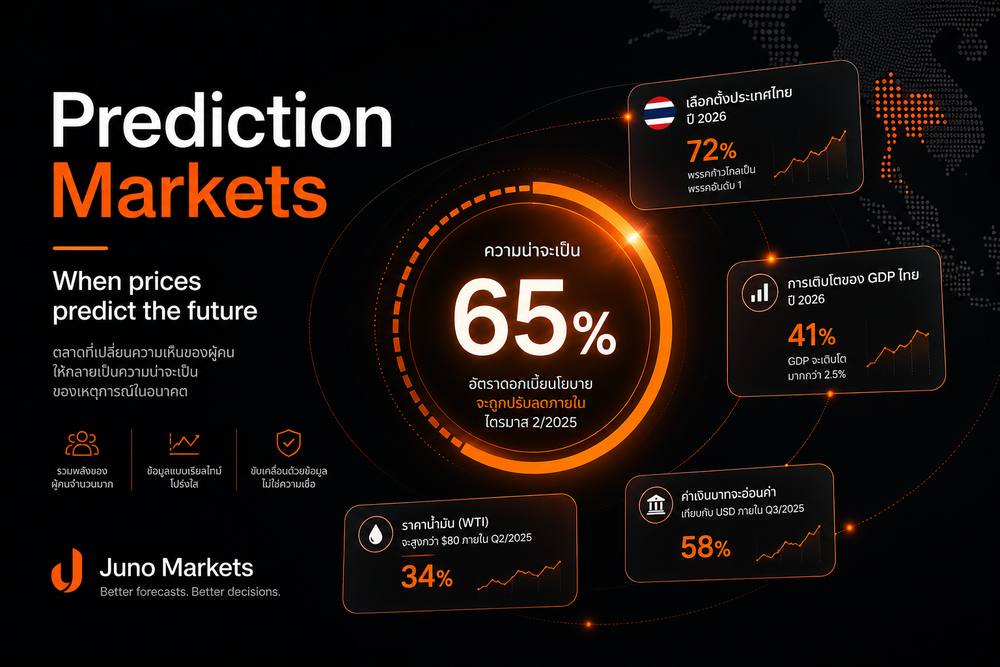
A prediction market is a platform where people trade the outcome of future events.
For example:
“Will the Bank of Thailand cut interest rates this year?”
Participants can buy:
- “Yes”
- or “No”
Prices range from 0 to 1:
- If “Yes” trades at 0.70 → the market implies a 70% probability
- If the event happens → it pays 1.00
- If not → it goes to 0
Prices are not set by the platform.
They emerge from real supply and demand between participants.
Why They Work Better Than Polls
The difference is incentives.
- Polls → no accountability
- Markets → participants commit capital
When people have skin in the game, they think more carefully.
This reflects the concept of The Wisdom of Crowds —
large, diverse groups can outperform individual experts when their views are aggregated properly.
Prediction Markets ≠ Gambling
This distinction matters.
| Gambling | Prediction Markets | |
|---|---|---|
| Price setting | House | Market participants |
| Structure | House edge | No structural edge |
| Purpose | Entertainment | Information aggregation |
| Output | Odds | Probabilities |
Prediction markets behave more like financial markets than betting systems.
Why This Matters for Thailand
Thailand is entering a period of uncertainty:
- Economic slowdown
- Policy shifts
- Interest rate ambiguity
- Global macro pressure
In this environment, a tool that reflects
what the market collectively believes
is far more useful than isolated opinions.
Conclusion
Prediction markets are not crystal balls.
But they are one of the most powerful tools for
turning collective intelligence into measurable probabilities
And in an uncertain world — that’s a serious advantage.
In the next article, we’ll explore the idea of
The Wisdom of Crowds — and why many people together often outperform any single expert.